Tuesday, February 15, 2011

All about Kingdoms!

Today, we started off class by turning in our Cornell Note on 18.3 that were due yesterday. We then moved on by talking about the Animal of the day #2. Today's animal was...the...STAR NOSED MOLE! Its class is a mammal.  It had an odd looking nose, which made it unique.
After that, we took notes on Kingdoms:

6 Kingdom System:

-As things evolve they get more complex
-They share a common ancestor
-"Protista"-they don;t know if they should call it a   kindom.


Three Domain System:
-3 Domains: Bacteria, Archea, and Eukarya.
-A more current taxonomic arrangement.
-Based on comparisons of tRNA sequences.


Archeabacteria and Eubacteria: (REVIEW)
-Formally the kingdom Monera
-Single-celled prokaryotic
 -Archeabacteria
    -No pepridoglycan
    -Found in harsh environments
 -Eubacteria
    -Peptidoglycan in cell wall
    -Most bacteria we encounter

Kingdom "Protista":
-Eukaryotic
-Most unicellular, some are multicellular
-Heterotrophic or autotrophic (photosynthetic)
-Very diverse kingdom
     (amoeba, paramecium, algae, euglena)

Kigdom Fungi:
-Eukaryotic
-Single or multicellular
-Cell wall made of chitin
-Decomposers/Heterotrophs
     (mushrooms, yeast, mold)

Kingdom Plantae:
-Eukaryotic
-Multicellular
-Autotrophic
- Cell Wall composed of cellulose

Kingdom Animalia:
-Eukaryotic
-Multicellular
-Heterotrophic
-No cell wall

After all those notes, we started the Shark Key. It is located on pages 9-12 in the UP. On page 12, we have to make our own biological key in both the fish and the leaves!

HOMEWORK:
*Finish Shark UP (9-12)
*Invert Profile, Due: 2/22
*Read Section 26.1
*TV add Due: 2/28


Calie is our next scribe!

Monday, February 14, 2011

NEW UNIT (:

Today, we started a new unit about the animals, but first, Mrs. Stein gave us grade reports and we saw what we got on the Evolution Test. She told us that we got a good head start on the new semester! After that we had a POP QUIZ on 18.1 **she sort of told us there would be one.** 18.1 was about classifying species and the order of diversity. Once we took the quiz, we took notes on the Animal Of The Day #1. We took notes on a hagfish, which is a slimy, eel like fish that has survived for millions of years. Then, Mrs. Stein introduced to us the Profile Project, where we are going to be invertabrates, an animal without a backbone, and we will create a profile. The project can be found on UP 3. Then, the learning came, and we took notes (:


TAXONOMY
*science of organizing and classifying organisms
*based on evolutionary relationships and biochemical and DNA similarities.

*~*~*CLASSIFICATION SYSTEM *~*~*

KINGDOM
PHYLUM
CLASS
ORDER

FAMILY
GENUS
SPECIES


*~*~*WAYS TO HELP YOU REMEMBER THE CLASSIFICATION*~*~*


King Philip Cuts Open Five Green Snakes

Kids Prefer Cheese Over Fried Green Spinach

King Phylum Class Ordered the Family Genius to SHUT-UP!


NAMING SYSTEMS:
*binomial nomenclature-genus and species name
*uses Latin
*developed by Carolus Linnaeus
-example: Homo Sapiens


*~*~*~*~HOMEWORK*~*~*~*~*~

~read 18.3 and cornell notes due tomorrow

~TV AD due 2/28
~PROFILE due 2/22

THE NEXT SCRIBE WILL BE.........Anastasia :)

Tuesday, February 8, 2011

Monday, February 7, 2011

Quite a tastefull day today.....

Today was a more laid back day in biology class. Basically we reviewed what we went over on Friday and took a few notes on our next section; the early history of earth. Basically all we got was that when the earth was first formed which was about 4.5 billion years ago, the atmosphere was composed of CO2, N2, water vapor, CH4, and H25. The first organic molecules were proven to exist if the atmosphere was as how it was believed to be. Two scientists proved this by conducting an experiment. In it they reproduced the conditions of what the atmosphere was believed to be like in ancient earth. They then sent electric sparks into the solution as if it were lightning. They next took a sample of the water that had formed and let it sit. After about two weeks, amino acids had started to form. this proves that if the atmosphere was what it was in the experiment then that's how the amino acids formed, starting a chain effect that would eventually lead to the development of DNA and RNA.
We did a short lab to demonstrate radioactive decay. We took 100 m&m's in a cup and shook the cup for 10 seconds. We then poured out the m&m's onto a plate and removed all the ones with the m symbol facing up. we the put the m&m's remaining back into the cup and repeated the earlier steps until there was none left. If you looked at the chart we filled out it would show that about each time we removed m&m's there was about half of them left this saying that the 10 seconds was like the half life of the substance that the m&m's represented.

The HW is...-UP 31 and 32
- 2.6 and check my understanding chart (due Wednesday)
-work on your TV add
-test Friday!!!!

The next scribe will be......... Mirella!!!

Sunday, February 6, 2011

What?!?!? Evolution involves Genatics?

Today in biology class, we talked about way that a species can eventually become two or mare than that. Basically it is all in the genetics, I genes change then the species becomes different. How or why do the genes change? Well one main reason is genetic drift. Genetic drift is when a number of species are moved to a different environment or the environment changes very fast in a small amount of time. This causes the animal to adapt in order to survive, or natural and/or artificial selection takes place. Over time the species becomes different creating a whole new species.


We also talked about other things like speciation. This is the ways a species evolves over time. There are two ways a species can evolve: punctuated equilibrium and gradualism. Punctuated equilibrium is when a species has long periods of stability and the short periods of rapid change. Gradualism is when a species changes at a slow steady rate. For this to happ3en you need several things; you need complete isolation and that the organism, and the organism cannot interbreed with another species.


Another thing that can spark a movement to change in a species is adaptive radiation. Adaptive radiation is when a species changes due to environment. If the environment changes so does the species in order to survive. One prime example is the finches on all the Galapagos Islands. They are slightly different on each island.

We also brushed over some other topics, these include;
Convergent Evolution: two different species, that are similar due to living in the same environment (ex. Butterflies and birds).
Co-evolution: organisms with close ecological relationships (ex. Plants and insects)

We then shifted subjects, and moved onto dating (not the kind where two people go out, but the kind to tell how old a fossil is). There are two ways scientists can tell how old a fossil is. One way is relative dating. Relative dating is were scientists look at the layer of rick or ground were the fossil is found, and depending on how old the layer is, that’s how old the fossil should be. The other way is through carbon dating. Since all thing need carbon, everything will have carbon in it. One an organism dies, it stops creating carbon. The carbon then starts to decompose. Carbon 14 and any other chemical will always decompose at the same rate. For carbon, half will be gone in 5770 years. This is known as a half life. A half life is how long it takes for half the mass of a chemical to decompose. So to tell how old a fossil is all you need to do is know how much carbon was originally there, know how much is left and then by counting half lives you can tell how old a fossil is. The only drawback is if there is not enough carbon then this wont work.

Don’t forget the homework!!:
-Read 19.3 and do a flow map on that
-finish UP 33-35
- Also don’t forget about your TV add due 2/28
-Test Wednesday


Here are some useful videos if you need any additional help;

http://www.youtube.com/watch?v=81dWTeregEA
This one explains carbon dating well

http://www.youtube.com/watch?v=tKj2s3VVI0M
This one show great example of Convergent evolution for animals with wings.

Wednesday, February 2, 2011

It's Snowmageddon! A Blizzaster!, The Snowpolalypse!

Hey everyone! Hope you are enjoying your day off! If you are reading this, post something about your snow day!  Maybe a picture of the snow?  So, just a friendly reminder that it would be WONDERFUL if you keep on track with the homework on moodle.. you will not be penalized if you don't, however, your weekend will be bogged down with homework if you don't!  Why am I asking you to do this?

1.  The test is STILL planned for next week (last I hear, still Weds.... but now that tomorrow is cancelled to, not sure if that will be)
2.  The test will STILL cover the same information
3.  You're gonna have to do it anyway!
4.  You'll have less to do over the weekend!

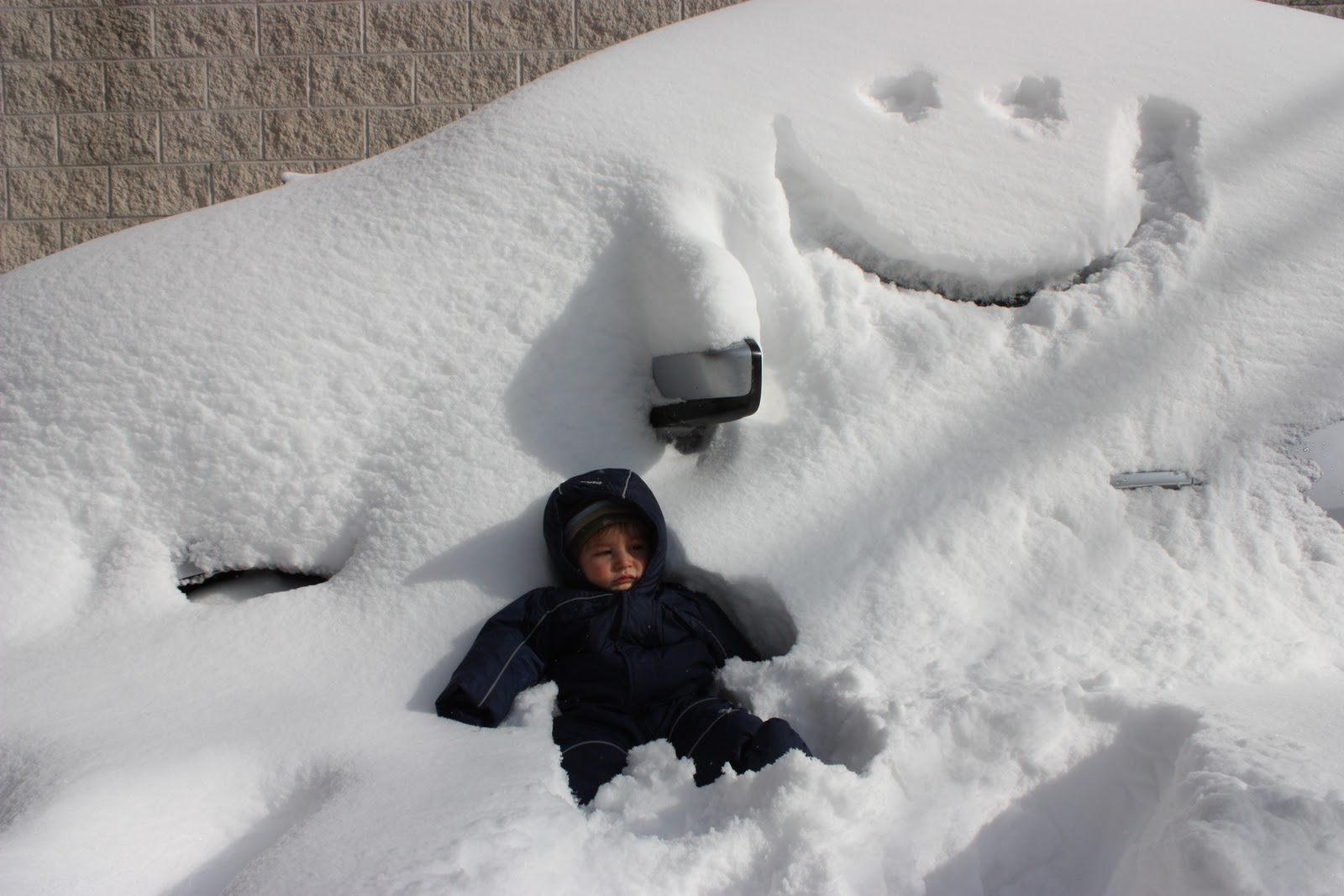
That is my CAR behind Max!!!
Be safe everyone!  See you soon!

Tuesday, February 1, 2011

February 1, 2011 - SNOW DAY TOMORROW!!

Agenda:
  • Show Mrs. Stein UP 26 (the endangered animal sheet) plus the "Picture This!" homework
  • Enjoy Matt's post and it is revealed that I am to be the scribe today
  • Evidence for Evolution Quiz
  • Discuss and grade quiz
  • Lab 38

We started off the class period by showing Mrs. Stein our UP 26 and Picture This! homework and received a homework stamp sheet. Then we were handedBold back our breakfast for birds lab (UP 4-8). We then spilt into partners or worked by ourselves and did a Evidence for Evolution quiz on such terms as Homologous, vestigial and analogous structures. We then graded our quizzes in class and took a few notes on the terms:

Comparative Anatomy- the study of similarities and differences between species' bodies.
Homologous Structures- similar bone structures
Comparative Embryology- examine and compare embryos of organisms
Analogous Structures- different organisms began living in similar environments, their appendages evolved to perform the same function.

Then we did "Lab 38" which is located in our biology lab books. Mrs Stein explained how we have to color the bones in the animal diagram and then answer the questions. We finished off class by finishing the lab and hearing how the travel advisory for today was "life threatening" from Mrs. Stein.

Homework:
  • finish the lab
  • Read 19.2
  • T.V. ad 2/28
Snow day on wednesday so all the homework except the t.v. ad is due on thursday.

our next scribe will be...... Amanda!!!!